
LED Billboard Advertising in Bangladesh: How It Works
 Ahmed Al MasumDirector of Marketing, AD Pro · 18 November 2026 · 8 min read
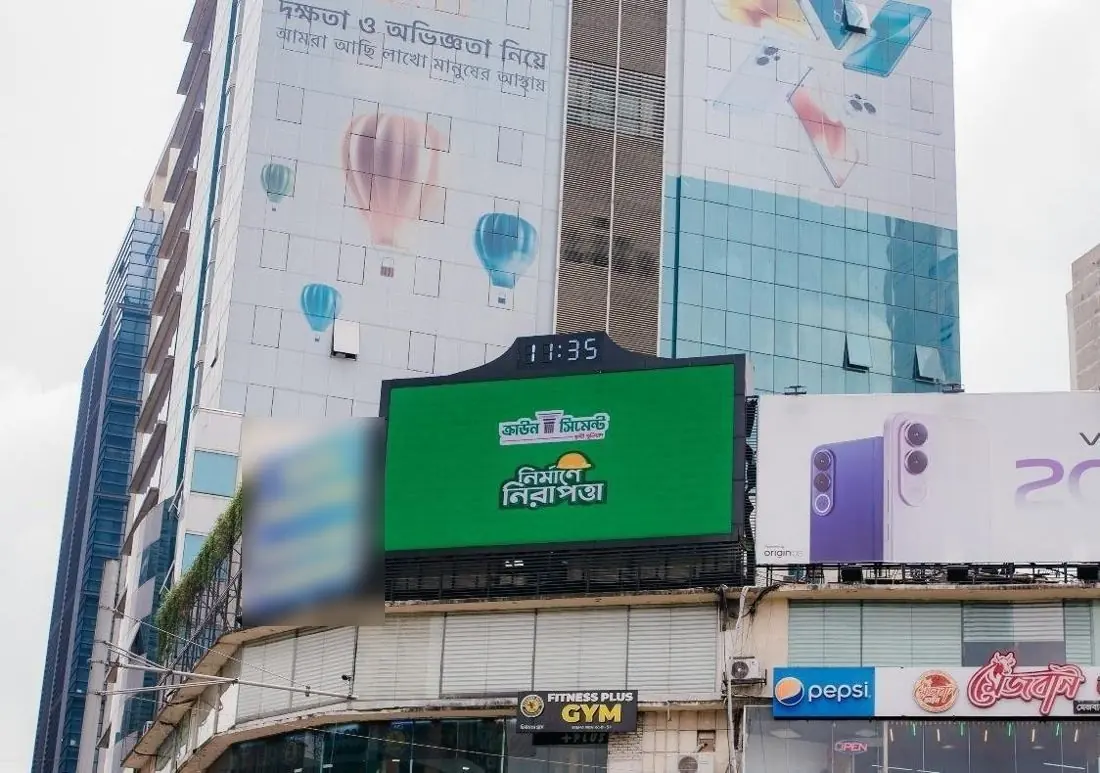
You are stuck at a signal in Gulshan. The big screen above the roundabout plays one brand, then another, then a third, and then the first one comes back. Who decides what plays, for how long, and how does a brand know its ad really ran? It is less mysterious than it looks.
The short answer: LED billboard advertising in Bangladesh is sold as airtime. You book a number of minutes a day on each screen, starting from that screen's minimum, and your short video plays in a loop with other brands during the screen's on-air hours. You send one MP4, AD Pro schedules it, and when the campaign ends you get a log summary as proof of play.
How LED billboard airtime is booked in Bangladesh
LED billboard airtime is booked as minutes a day on each screen, for the number of days in your campaign. You do not rent the whole screen. You share it.
Here is the analogy I use. A static billboard is like renting a shop: the whole face is yours, day and night. An LED screen is more like buying airtime on a TV channel that happens to stand at a roundabout. Several brands take turns, and each one gets the minutes it booked.
So a booking has three parts:
- The screens. AD Pro has LED billboard screens in 10 cities.
- The minutes a day on each screen. Each screen has a minimum.
- The number of days.
On most AD Pro screens the minimum airtime is 60 minutes a day. A few start at 30 minutes a day, including the Dhanmondi-27, Mid Island screen, the Narayanganj screen and all five Chattogram LED screens. One screen, Kandirpar in Cumilla, starts at 70 minutes a day.
The rest depends on which screens you pick, how many minutes you take and your dates. AD Pro shares a plan when you call.
How long is an LED billboard ad?
A standard LED billboard ad is around 15 seconds. That is the standard spot on AD Pro's screens.
The maths is simple. Four 15-second spots fit into one minute. So:
- 60 minutes of airtime a day works out to 240 plays a day on one screen.
- 30 minutes a day works out to 120 plays.
My rule for a 15-second spot is one idea, one line, one logo. If a person at the signal cannot tell what you sell without hearing a word, the spot is trying to do too much. I would also design for the eyes only. Nobody behind a closed car window is listening.
LED billboard video specs: what format does the screen need?
An LED billboard needs an MP4 video made at the resolution of the screen. On most AD Pro screens that is 1920 × 1080, the same landscape shape as a television. You send one MP4, and AD Pro adapts it to every screen size in your plan.
Landscape and portrait screens
Not every screen is wide. Some are tall, and a wide video squeezed into a tall screen looks like a wedding photo cropped down to one uncle.
A few real examples from the network:
- Landscape: Gulshan Circle-1, Upper is a 30 × 20 ft screen that takes a 1920 × 1080 video.
- Portrait: Police Plaza, Front Side is 10 × 13 ft and takes 1080 × 1920.
- Portrait, indoor: Shimanto Square has six synchronised indoor screens, each 2.6 × 4 ft at 1080 × 1920, booked as one set.
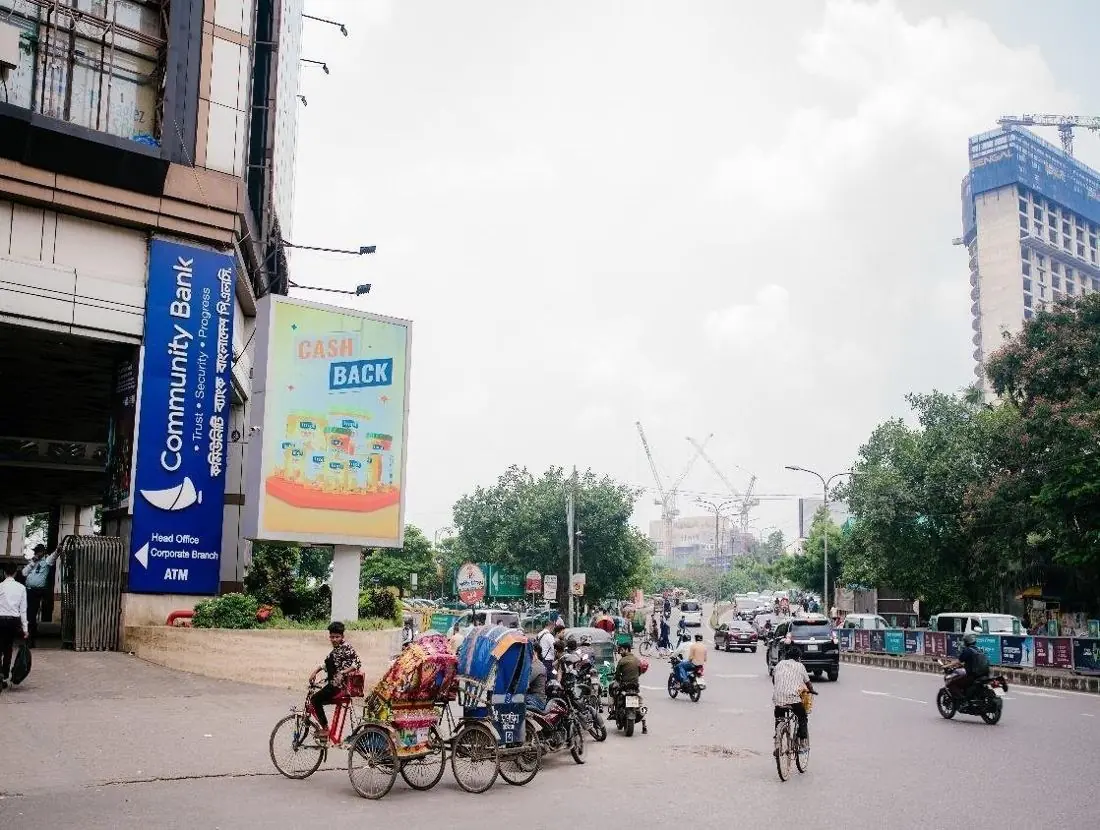
If your plan mixes wide and tall screens, tell your designer on day one. I would keep the logo and the main line near the centre of the frame, so nothing important is lost when the video is adapted to a different shape.
Pixel pitch explained: what do P5 and P6 mean?
Pixel pitch is the gap, in millimetres, between the centre of one pixel and the next. P5 means 5 mm. P6 means 6 mm. The smaller the number, the closer the pixels sit, and the sharper the picture looks from close up.
Think of a painted rickshaw panel. From across the road it looks perfect. Stand right next to it and you see every brush stroke. A screen is the same, so the right pitch depends on how far away the viewer stands.
You can see this in how AD Pro's screens are built:
- P3 at the Police Plaza entry gates. These are fine-pitch screens at arm's length, and shoppers walk straight past them.
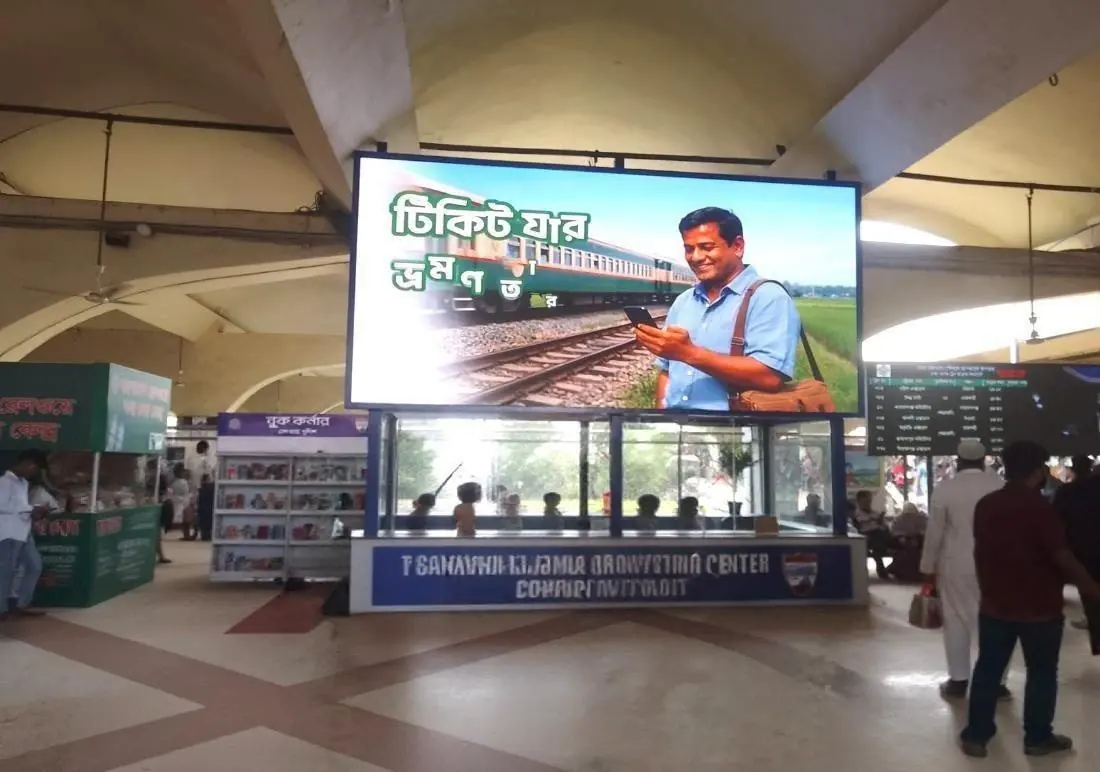
- P4 at the entry gate of Kamlapur Railway Station, where passengers wait with time to watch.
- P5 and P6 on most roadside screens, such as the Gulshan circles and the Dhanmondi screens.
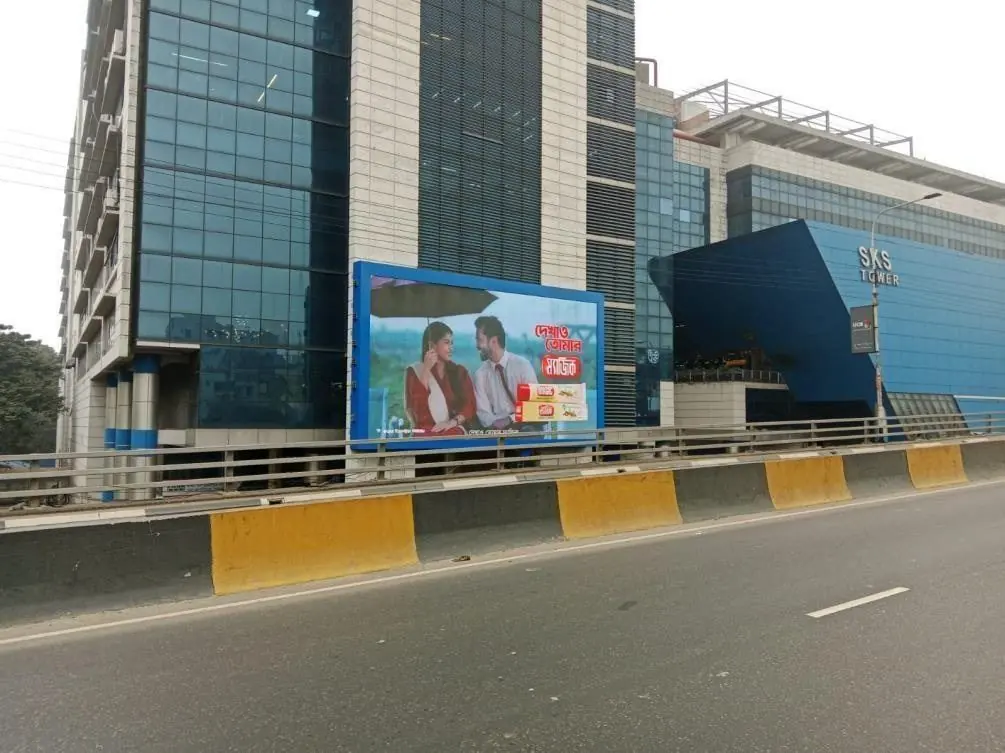
- P10 on the SKS Tower flyover-view screen, which is 50 × 30 ft and faces the Mohakhali Flyover.
So should you chase the smallest number? I would not. Pitch only matters in relation to distance, and a very large screen is built to be read from far away. What matters more to you is the resolution of the file you send.
Real LED screen specs from AD Pro's network
Here are six real screens, picked to show how far the specs can differ from one site to the next.
| Screen | Size | Pixel pitch | Resolution | On-air hours |
|---|---|---|---|---|
| Gulshan Circle-1, Upper, Dhaka | 30 × 20 ft | P5 | 1920 × 1080 | 7 am to 7 pm |
| SKS Tower, Flyover View, Dhaka | 50 × 30 ft | P10 | 3840 × 2160 | 7 am to 7 pm |
| Police Plaza, Front Side, facing Gulshan-1, Dhaka | 10 × 13 ft | P5 | 1080 × 1920 | 7 am to 7 pm |
| Police Plaza Entry Gate (South), Dhaka | 6.5 × 9.5 ft | P3 | 640 × 960 | 9 am to 7 pm |
| Kamlapur Railway Station (Entry Gate), Dhaka | 18 × 12 ft | P4 | 1080 × 640 | 7 am to 7 pm |
| Kandirpar, Cumilla | 8 × 14 ft | P4 | 1920 × 1080 | 5 pm to 9 pm |
Notice the last column. On-air hours are not the same everywhere, which brings us to the next question.
What hours are LED billboards on air?
Most AD Pro LED billboards are on air from 7 am to 7 pm. Each screen plays a loop of short spots through the day, so your booked minutes are spread across those hours and your ad keeps coming back.
A few screens keep different hours, and it is worth knowing them before you plan:
- 9 am to 7 pm: the two Police Plaza entry gate screens and the indoor screens at Shimanto Square.
- 5 pm to 9 pm: Kandirpar in Cumilla. It runs in evening prime time only, on the city's main square.
- 12 hours a day: the Feni City Network, a set of 188 small-format screens in shops and outlets across Feni.
The hours are listed on each screen's page, so check them the same way you check the size. If yours is an evening product, say a restaurant offer, I would look hard at a screen with evening hours before a larger one that goes dark at seven.
Proof of play: how do I know my ad was actually played?
You know because you get a record. Every AD Pro campaign ends with a log summary. That is your proof of play: it shows what played and where, so you can show your team that the airtime you booked is the airtime that ran.
This matters more with LED than with a static board. A printed billboard is either up or it is not, and anyone can drive past and look. A 15-second spot is gone before you find parking. Without a log, you are taking it on trust.
AD Pro schedules your video and monitors playback while the campaign runs. My advice for any LED booking, with anyone: ask what proof of play you will get before you sign, not after.
Digital billboard advertising, step by step
From first call to on air, digital billboard advertising with AD Pro takes six steps, and a campaign is on air within 48 hours of your content being approved.
- Pick your screens. For LED screen advertising in Dhaka, start with the Dhaka sites, or go straight to a cluster such as the Gulshan screens. Outside the capital, Sylhet has eight screens, all 15 × 10 ft and P6.
- Choose the minutes a day and the number of days. Remember each screen's minimum airtime.
- Check the specs. Note the resolution and shape of each screen in your plan.
- Send one MP4. AD Pro adapts it to each screen and schedules it.
- Go on air. If your message changes, send a new video. A teaser this week and the offer next week needs no reprint.
- Get your log summary. Keep it for your campaign report.
Conclusion: book minutes, send one MP4, ask for the log
LED billboard advertising in Bangladesh comes down to a few plain facts. You book minutes a day on each screen, from a minimum of 30 or 60 on almost every screen. Your spot is around 15 seconds. You send one MP4 at the screen's resolution and watch out for portrait screens. Pixel pitch tells you how fine the screen is, and most screens are on air from 7 am to 7 pm. At the end, the log summary shows what played.
The next step is to find out which screens are open for your dates. Call or WhatsApp AD Pro on +880 1958-503753 to check availability, and we will share a plan. Or browse every screen with its photo, size and specs in the locations directory.
Frequently asked questions
- How long is an LED billboard ad?
- A standard spot on an AD Pro screen is around 15 seconds. Airtime is booked as minutes a day, so 60 minutes a day gives a 15-second spot 240 plays on one screen, and 30 minutes a day gives it 120 plays.
- What video format does an LED billboard need?
- An MP4 video at the resolution of the screen. Most AD Pro screens take a 1920 × 1080 file, while some portrait screens, such as Police Plaza, Front Side, take 1080 × 1920. You send one MP4 and AD Pro adapts it to each screen in your plan.
- What does pixel pitch (P5, P6) mean?
- Pixel pitch is the gap in millimetres between the centre of one pixel and the next. P5 means 5 mm and P6 means 6 mm. A smaller number gives a sharper picture up close, so P3 suits walk-past screens and P10 suits very large screens seen from far away.
- How do I know my ad was actually played?
- Every AD Pro campaign ends with a log summary. This is your proof of play. It shows what played and where, so you can show your team that the airtime you booked is the airtime that ran.
- What hours are LED billboards on air?
- Most AD Pro LED screens are on air from 7 am to 7 pm. A few differ: the Police Plaza entry gate screens run from 9 am to 7 pm, and Kandirpar in Cumilla runs from 5 pm to 9 pm. Check the hours listed for each screen before you plan.