Tri-vision billboards explained: three messages on one board
 Ahmed Al MasumDirector of Marketing, AD Pro · 16 November 2026 · 8 min read
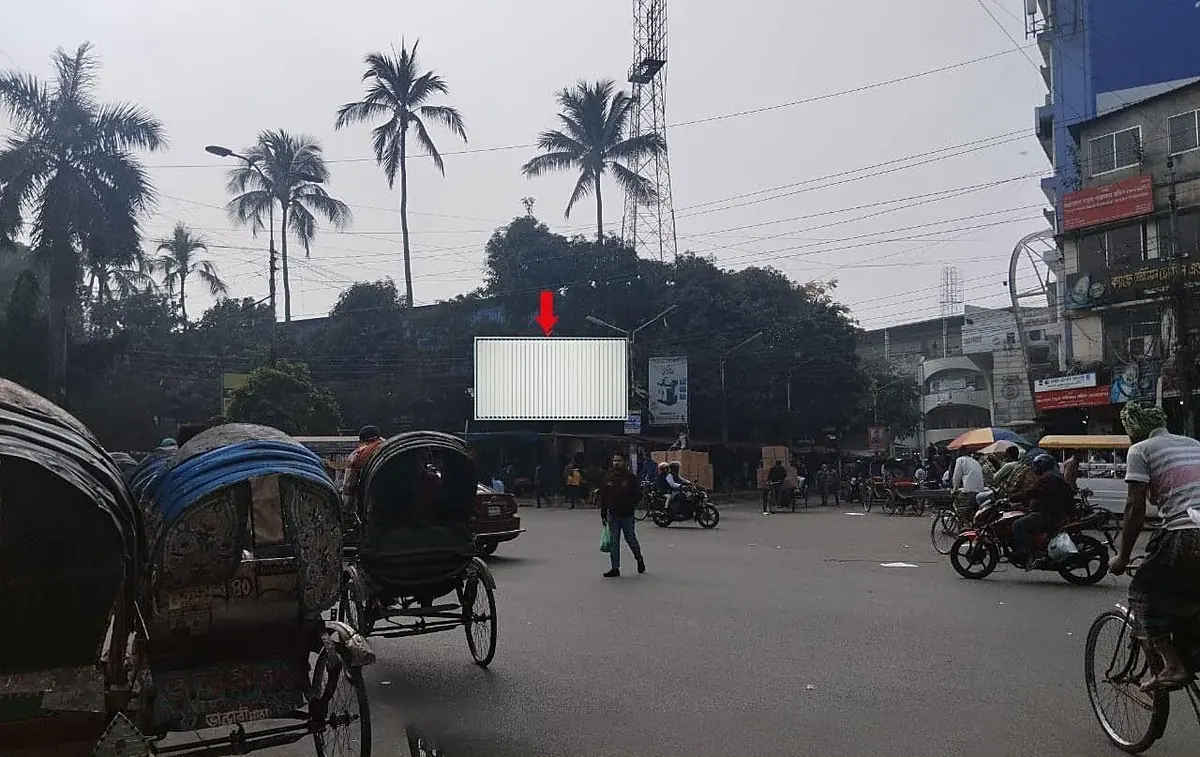
You are stuck at a signal in Motijheel. The billboard ahead shows a product. Then, with a soft clack, the whole face turns and a new message appears. A moment later it turns again. You did not plan to watch a billboard today, yet here you are, waiting for the third one.
That is a tri-vision billboard. It is a printed board built from a row of three-sided slats that turn together, so one frame shows three different faces in turn. You get three messages from one location, with movement that pulls the eye, and no screen involved.
What is a tri-vision billboard?
A tri-vision billboard is a billboard whose face is made of long triangular slats instead of one flat sheet. Each slat has three sides. When all the slats show the same side, you see one complete picture. When they turn, you see the next one.
You will also hear it called a rotating billboard or a three-sided billboard. All three names describe the same thing. I like to think of it as a three-page book that turns its own pages, in public, all day.
It is still print. There are no pixels and no video file, so it reads like a normal billboard. It just has three faces instead of one.
How does a tri-vision billboard work?
A tri-vision billboard works by turning a row of triangular slats at the same moment, so the whole face changes from one printed design to the next. Here is the sequence, step by step:
- Three designs are printed. Each design is made for the full face of the board.
- Each design is cut into strips. One strip goes on one side of each slat, so every slat carries a slice of all three designs.
- The slats turn together. A mechanism turns every slat by a third of a full turn at once, and the next design lines up across the frame.
- The face holds, then turns again. Each design stays still long enough for people to read it. Then the cycle moves on and repeats.
That is the whole trick. Simple, mechanical, and oddly satisfying to watch.
How many ads can one tri-vision board show?
One tri-vision board shows three ads, one on each face. I would give all three to one brand, or to one group showing three products, because the faces share a frame and people read them as a set. On our sites each face is 20 × 10 ft, which gives you 600 sq ft of display from a single frame.
Why a rotating billboard gets noticed
A rotating billboard gets noticed because it moves, and the boards around it stay still. Our eyes are built to catch movement.
There is a second effect, and I think it is the stronger one: curiosity. Once you have seen a board change, you want to know what comes next. Have you ever watched a lift counter tick down even though staring will not make it faster? Same habit.
Dhaka traffic helps here too. Nobody enjoys a long signal, but a driver or a passenger who is held in front of a board for a while can see all three faces, not just one. A static board gives that person one message. A tri-vision board gives them three, then starts again.
Three ways to use the three faces
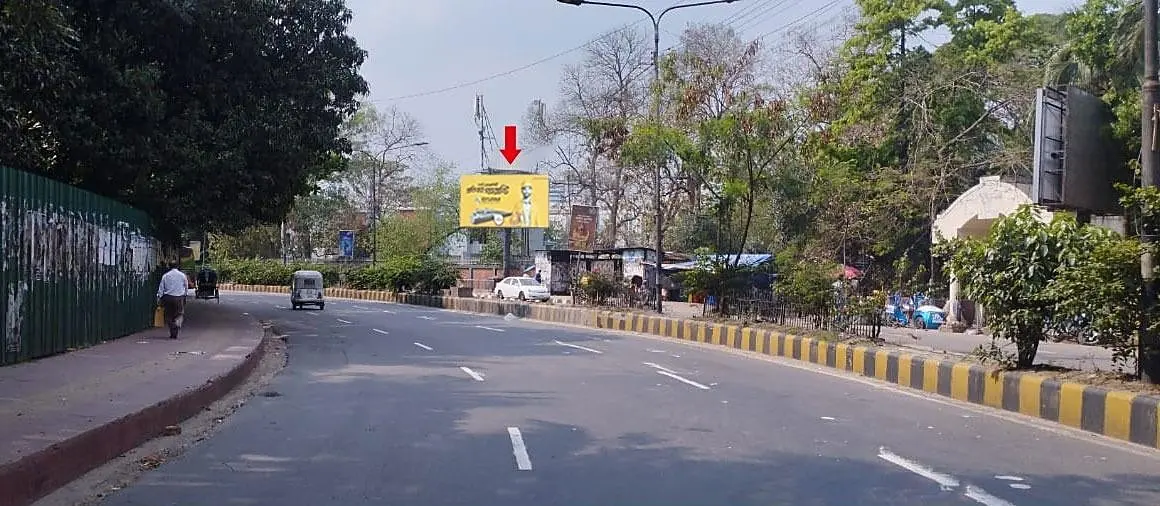
The best way to use a tri-vision board is to plan the three faces as one campaign, not as three unrelated posters. These are the three approaches I would look at first.
1. Product, offer, call to action
Face one shows the product. Face two gives the reason to act now, such as an Eid offer or a new season. Face three tells people what to do: visit a showroom, download the app, call a number. Each face has one job, so none of them is crowded.
2. Three products from one brand
If you have a range, give each product its own face. A bank could show savings, cards and its app. A food brand could show three flavours. A real estate company could show three projects. Keep the logo, colours and layout the same on all three so people know it is one brand talking.
3. A story in sequence
This one is my favourite. Face one asks a question. Face two builds on it. Face three gives the answer and the brand. It turns a billboard into a tiny three-panel comic.
One warning, though. My rule is that every face must make sense on its own. Someone in a moving bus may catch only one of the three. If face two means nothing without face one, a third of your board is wasted. So put the brand name on every face, even in a story sequence.
Where are tri-vision billboards in Dhaka?
AD Pro has three tri-vision billboard sites in Dhaka: Jibon Bima Tower at Stadium Gate 3 in Motijheel, Tennis Club in Shahbagh, and Paribagh. All three are the same format, so one set of artwork sizes works across them.
| Site | Area | Facing | Size | Display area |
|---|---|---|---|---|
| Jibon Bima Tower, Stadium Gate 3 | Motijheel | Motijheel / Dainik Bangla | 20 × 10 ft × 3 faces | 600 sq ft |
| Tennis Club, Shahbagh | Shahbagh | Motsho Bhaban | 20 × 10 ft × 3 faces | 600 sq ft |
| Paribagh | Paribagh | Bangla Motor | 20 × 10 ft × 3 faces | 600 sq ft |
- Motijheel. Motijheel is Dhaka's old commercial centre, known for banks and head offices. The board at Jibon Bima Tower sits at Stadium Gate 3 and faces Motijheel and Dainik Bangla. If your customers are office workers and business people, start here. You can see our other billboard sites in Motijheel on the area page.
- Shahbagh. Shahbagh is known for its universities, hospitals and cultural life, so the crowd is mixed: students, families, hospital visitors and office staff. The Tennis Club board faces Motsho Bhaban.
- Paribagh. The Paribagh board faces Bangla Motor, in the central part of the city. I would consider it for brands that want to stay in front of daily commuters.
If tri-vision advertising in Dhaka is on your plan and you are not sure which of the three fits, tell us who you want to reach when you call. We will share a plan, and you can compare it with the other outdoor sites in Dhaka.
Tri-vision vs static billboard vs LED screen
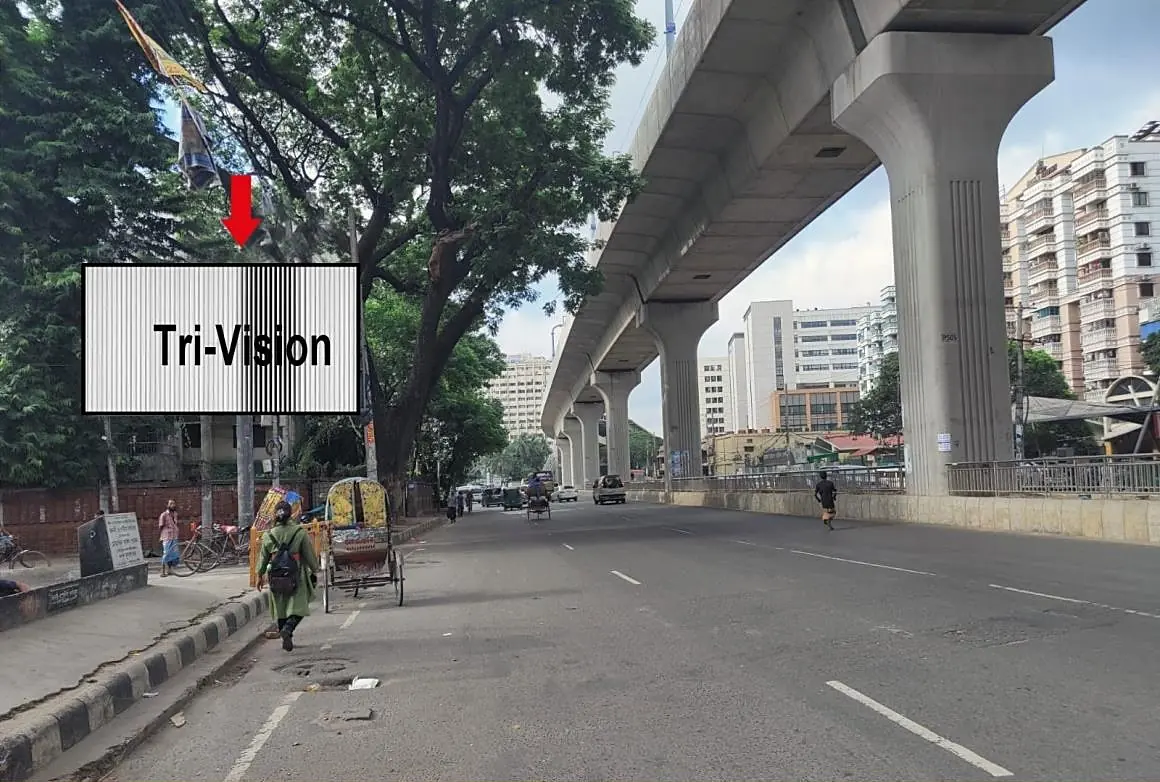
A tri-vision board sits between a static billboard and an LED screen: it has the printed look of the first and some of the movement of the second. To make the comparison fair, I have picked three AD Pro sites with the same 20 × 10 ft face.
| Format | What it shows | Movement | AD Pro example (20 × 10 ft) |
|---|---|---|---|
| Tri-vision | Three printed faces, shown in turn | The face turns between designs | Jibon Bima Tower, Stadium Gate 3, facing Motijheel / Dainik Bangla |
| Static billboard | One printed face | None | Motaleb Plaza, Hatirpool, facing Katabon |
| LED screen | Video and animated content | Full motion | Gulshan Circle-1, Mid Island, facing Police Plaza: P5 pitch, 1920 × 1080, on air 7 am to 7 pm |
So which one should you choose? Here is how I would think about it:
- Choose a static billboard when you have one strong message and want it to stay in place.
- Choose an LED billboard when you have video, or when your message changes often.
- Choose a tri-vision billboard when you have up to three things to say, you like the look of print, and you want movement without a screen.
Still weighing up the options? Our guide to outdoor advertising in Bangladesh covers the full range.
What artwork do I need for a tri-vision board?
For a tri-vision board you need three finished designs, one for each face. On AD Pro's sites each face is 20 × 10 ft, so every design is a landscape layout that is twice as wide as it is tall.
The slats add one thing that a flat billboard does not have: joins. Your design is sliced into strips, and thin gaps run between them. Good tri-vision artwork is designed with that in mind. These are the habits I would follow:
- Go big and bold. Large type and simple shapes survive the joins. Fine print and thin lines do not.
- Use few words. Each face is on show for a short time, so write for a glance. One idea per face.
- Keep the brand in the same spot. Put the logo in the same corner on all three faces. As the board turns, the brand stays fixed and the message changes around it.
- Mind the small details. Avoid placing eyes, small product details or phone numbers where a join might cut through them.
What about file sizes and print-ready formats? We confirm the exact artwork specifications for each site when you call. AD Pro also offers a printing service.
The short version
A tri-vision billboard is a printed board with three-sided slats that turn together, so one frame carries three faces. The movement gets it noticed, and the three faces let you sell, explain or tell a short story.
AD Pro has three of them in Dhaka: Jibon Bima Tower at Stadium Gate 3 in Motijheel, Tennis Club in Shahbagh, and Paribagh. Each is 20 × 10 ft with three faces and 600 sq ft of display. Bring three bold, simple designs with the brand on every face.
Want to know if a site is open for your dates? Call or WhatsApp +880 1958-503753 to check availability and we will share a plan. You can also browse the full site directory or send a message through our contact page.
Frequently asked questions
- How does a tri-vision billboard work?
- A tri-vision billboard has a row of long, three-sided slats. Three designs are printed, cut into strips and fixed to the sides of the slats. The slats turn together by a third of a turn, so the whole face changes from one design to the next, holds long enough to read, then turns again.
- How many ads can one tri-vision board show?
- One tri-vision board shows three ads, one on each face. The faces share a frame, so they work best for one brand or one group showing three products. Each face on our Dhaka sites is 20 × 10 ft, giving 600 sq ft of display.
- Where are tri-vision billboards in Dhaka?
- AD Pro has three tri-vision billboards in Dhaka. One is at Jibon Bima Tower, Stadium Gate 3, in Motijheel, facing Motijheel and Dainik Bangla. One is at Tennis Club, Shahbagh, facing Motsho Bhaban. One is at Paribagh, facing Bangla Motor. Each is 20 × 10 ft with three faces.
- What artwork do I need for a tri-vision board?
- You need three finished designs, one for each face. On AD Pro's sites each face is 20 × 10 ft, a landscape layout twice as wide as it is tall. Use large type, few words and the logo in the same place on every face. We confirm exact file specifications when you call.
- Is a tri-vision billboard the same as an LED billboard?
- No. A tri-vision billboard is print: three printed faces on slats that turn. An LED billboard is a screen that plays video and animated content. Tri-vision gives you movement and three messages with the look of a printed board, while LED suits video or messages that change often.